

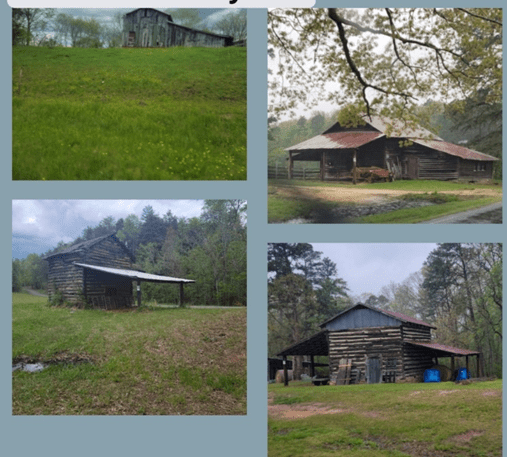
My fascination with “old country barns” sitting on a beautiful landscape runs pretty deep. My visit to my home state of North Carolina in the “tobacco belt” of the state really stirred it up again as I rode the long and winding roads. I think I finally understand the fascination with old barns. They represent the days of old when life supposedly was simpler and slower but more manually difficult. There were no instant messages, social media, uber eats or cell phones. Technology was represented with “maybe” one remote less TV, house phone and one bathroom or outside toilet. The black and white TV shuts off by itself at night after a certain time, maybe back then sleep was appreciated and valued more. Over 70% of food consumed was homegrown or fed. There were very few “8-hour days” but work was done until it was completed for that day.
Barns played a major role in the livelihood of farmers, including my family. Tobacco barns once numbered a half million and were fixtures on farms across the state of North Carolina. Today, only about 50,000 still stand, vestiges of the tobacco industry, deteriorating reminders of the leaves’ influence on our culture. Barn locations may look random, but in fact were carefully considered for efficiency, namely proximity to human labor and mule-drawn carts when the “cropping,” or harvesting, was underway. barns were deliberately located far enough apart to reduce the risk of fire. The tobacco barns would stand empty and unused — and unlovely — until the next season.
When I look at the old tobacco barns in fields. I see the beauty of the old days while others may see dilapidated, deteriorating barns in the fields. Questions like the following plagued my mind such as who was the original owner? How much was the barn used? Were the profits from using the barn able to meet the needs of the owners? Why were barns built in open fields all alone? Was the upkeep done continuously to keep the critters out or were there years of neglect? Was it built well enough to weather the cold winters and the hot summers while continuing to be used? If so, how long did it function fully for its’ original purpose?
Of course, the barn’s main purpose was to house tobacco and be dried with intense heat in order to bundle and sale for profit. However, were they utilized in some other ways? Did someone use the barn as a place of refuge? Their hideaway or sanctuary to lift up prayers. Was it the only place they felt peace or even safe? If those walls could talk? I wonder what they would say. Do they hold secrets of yester years that have never been spoken? Did their barn walls witness unspeakable acts being done? We will never know the stories of “the barn” because the original owners are long gone. However, the barns still stand not in their original form when built but tattered, inoperable and could not possibly function in its intended use. Nevertheless, it stands and now symbolizes the days of old and could be described now as iconic, historical, and picturesque for those who appreciate it.
My take on all of this is …just like the barns, we may not be functioning the way we were originally design because of what we have endured over the years. Maybe it was the loss of loved ones, dysfunctional relationships, or illnesses. In some ways we may be tattered and feel inoperable. Nevertheless, we continue to stand but unlike the uninhabited barns we can still find purpose and fulfillment.
Whether we realize it or not, God has already put purpose in our heart but how do we see it to fruition?
Glad you ask…my suggestions:
- Don’t focus on what you have lost but rather what you have left.
- Take what you have left and offer it back to the ONE who created you.
- Ask God to give you a dissatisfaction for the status quo and a desire for something better.
- Trust Him to show you next steps and do “only” that.
- Ignore the naysayers and doubting Thomas that cross your path.
- Don’t let anyone who hasn’t been in your shoes tell you how to tie your laces.
- Finally, remember overthinking kills happiness. As a man thinketh so is he (Prov 23:7). The heaviest burdens that we carry are the thoughts in our head.
Best regards,
Dr. G
 Dr.G....."Grace & Grit"
Hi Myrtle !
Beautiful blog great read. Loved your
message, viewpoint and resourceful perspective.
Being a country girl myself I certainly can
relate.
Thanks for sharing..
LikeLike
Enjoyed this insightful blog!!
LikeLiked by 1 person